Resources
College and university fund Conference
In December 2025, the Council convened institutional leaders from the College and University Fund for the Social Sciences (CUF) with leaders of philanthropic organizations and other research partners, for our 2025 CUF conference: “On Earning Trust: The Case for the Social Sciences.” With panels on trust in higher education, trust and societal institutions, and funder perspectives on trust, this conference explored the challenge of earning, sustaining, and restoring trust in universities, research, and more—through credible action, transparency, and shared moral purpose.
2025 Conference Recap: On Earning Trust

OVERVIEW
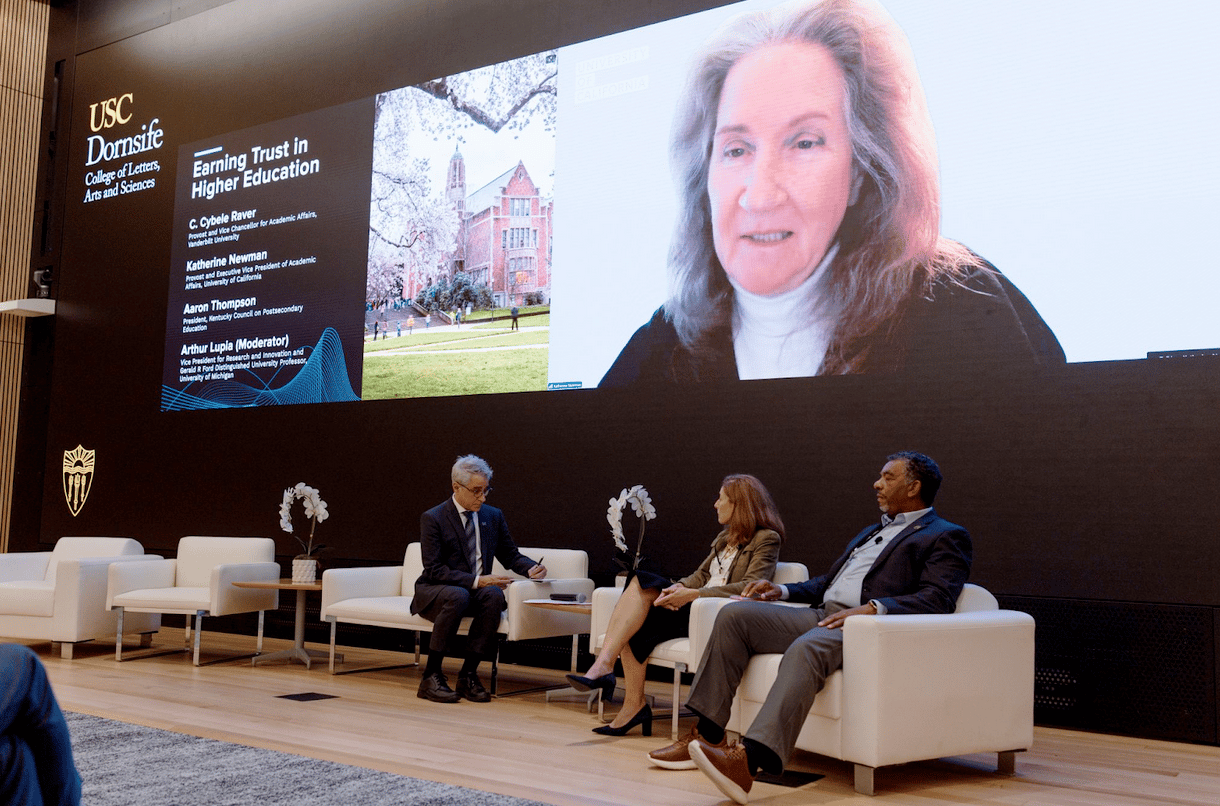
Clockwise from top: Panelists Katherine Newman (Provost and Executive Vice President of Academic Affairs, University of California), Aaron Thompson (President, Kentucky Council on Postsecondary Education), C. Cybele Raver (Provost and Vice Chancellor for Academic Affairs, Vanderbilt), and moderator Arthur Lupia (Vice President for Research and Innovation, University of Michigan) discuss trust in higher education.
Our first CUF panel “Earning Trust in Higher Education” explored how universities can regain public confidence through transparency, inclusion, and accountability.
Panelists discussed public perceptions including beliefs that college is too expensive, that the system is unfair to those who don't attend college, and that higher education encourages political indoctrination. Many people see universities as engines of stratification—vehicles for maintaining class hierarchy rather than promoting mobility. To combat this perception, panelists stressed that universities need to focus on demonstrating their community impact, particularly through research that addresses local challenges (one example: NYU's behavioral economics work helping the NYC Administration for Children's Services improve their caseworker training). In the above video, participant Aaron Thompson encourages universities and instructors to be explicit about the employability competencies that humanities and social science students develop through their learning.
Earning Trust in Higher Education
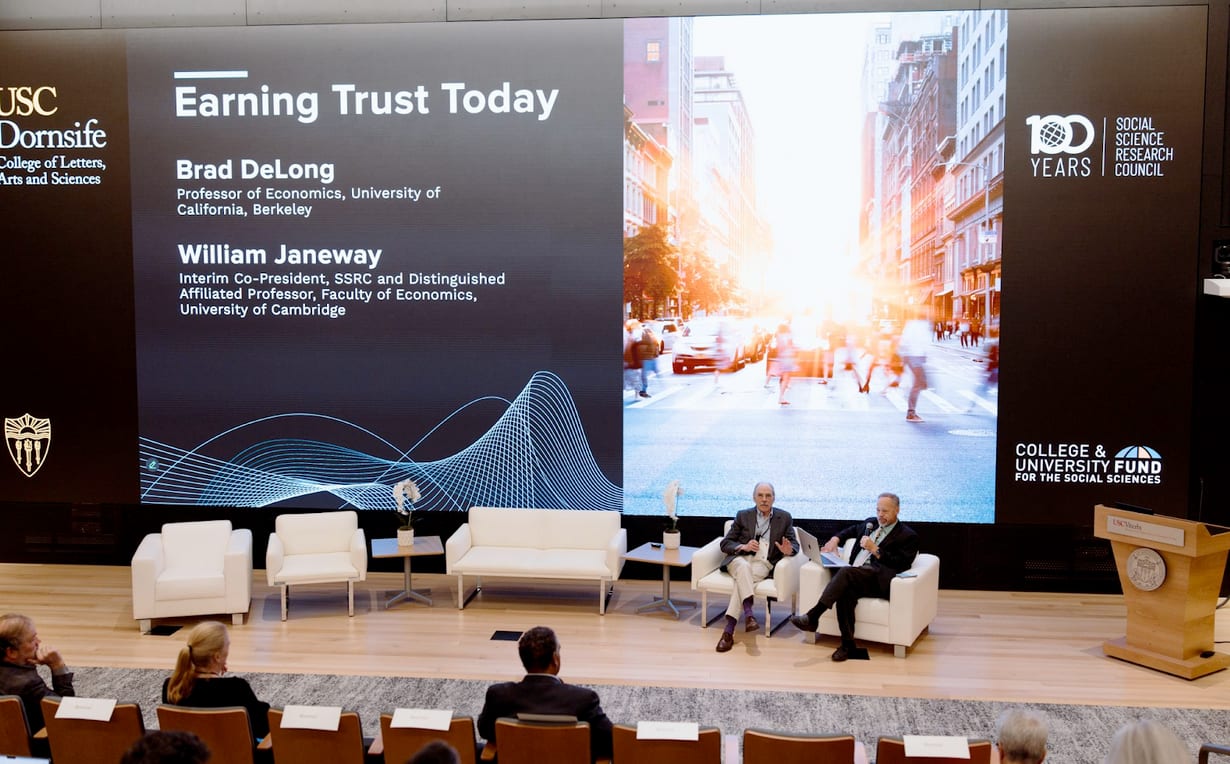
Earning Trust Today
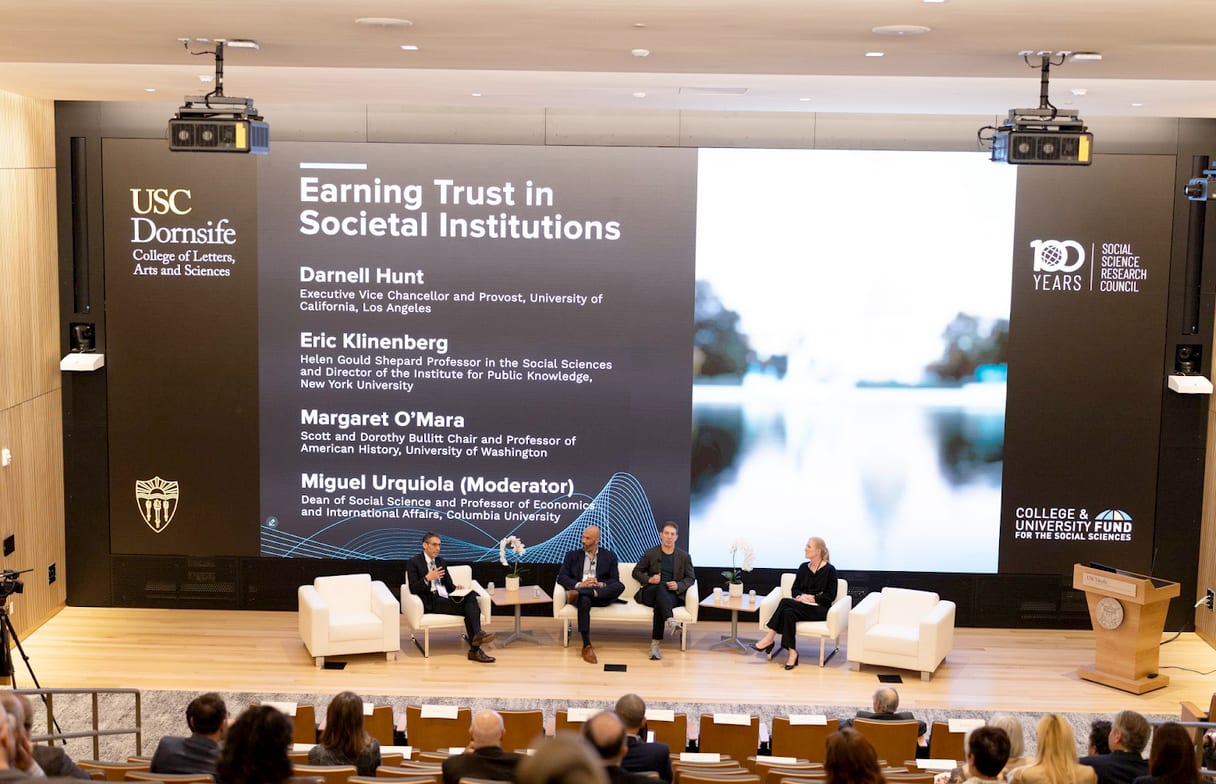
From left: Moderator Miguel Urquiola (Dean of Social Science, Columbia) and panelists Darnell Hunt (Executive Vice Chancellor and Provost, UCLA), Eric Klinenberg (Helen Gould Shepard Professor in the Social Sciences, NYU), and Margaret O’Mara (Scott and Dorothy Bullitt Chair and Professor of American History, University of Washington) discuss trust in societal institutions.
In this fireside chat, Brad DeLong and William Janeway discussed whether economic history has lessons relevant to today’s crisis of trust. Brad DeLong noted that current levels of institutional distrust are historically anomalous but not unprecedented—and trust can be rebuilt, though it requires sustained effort. He emphasized that economic anxieties, particularly around wage stagnation and wealth inequality since the 1970s, have contributed significantly to institutional distrust, as well as the fracturing of shared information environments. Bill Janeway emphasized that rebuilding trust will require universities to find ways to communicate the value of scholarly skepticism and intellectual humility without undermining their authority.
Earning Trust in Societal Institutions
Our second panel, “Earning Trust in Societal Institutions,” analyzed the conditions under which major social institutions gain or lose legitimacy—and how trust can be rebuilt across sectors. Panelists discussed the history of anti-intellectualism and perceived elitism in universities, as well as the importance of participatory processes in research in rebuilding trust, including deeper connections to local communities that go beyond discussion into co-creation of research.
Speakers Brad DeLong (right; Professor of Economics, University of California, Berkeley) and William Janeway (Interim Co-President, SSRC and Distinguished Affiliated Professor, Faculty of Economics, Cambridge University) discuss economic history and the role of trust in society.
In the above video, Margaret O'Mara provides a historical perspective on how the erosion of trust in universities was co-terminous with the destruction of trust in political institutions, describing how modern day Silicon Valley emerged from the eras of the Vietnam War and Watergate as an attempt to empower individuals rather than cede information and media control to institutions.
Funder Perspectives on Earning Trust
From left: Moderator Daniel Goroff (Senior Advisor, SSRC) and panelists Jonathan Holloway (President, Henry Luce Foundation), Sam Gill (President and CEO, Doris Duke Foundation), Caroline Montojo (President and CEO, Dana Foundation) and Amber Miller (President, Hewlett Foundation) discuss funder perspectives on trust.
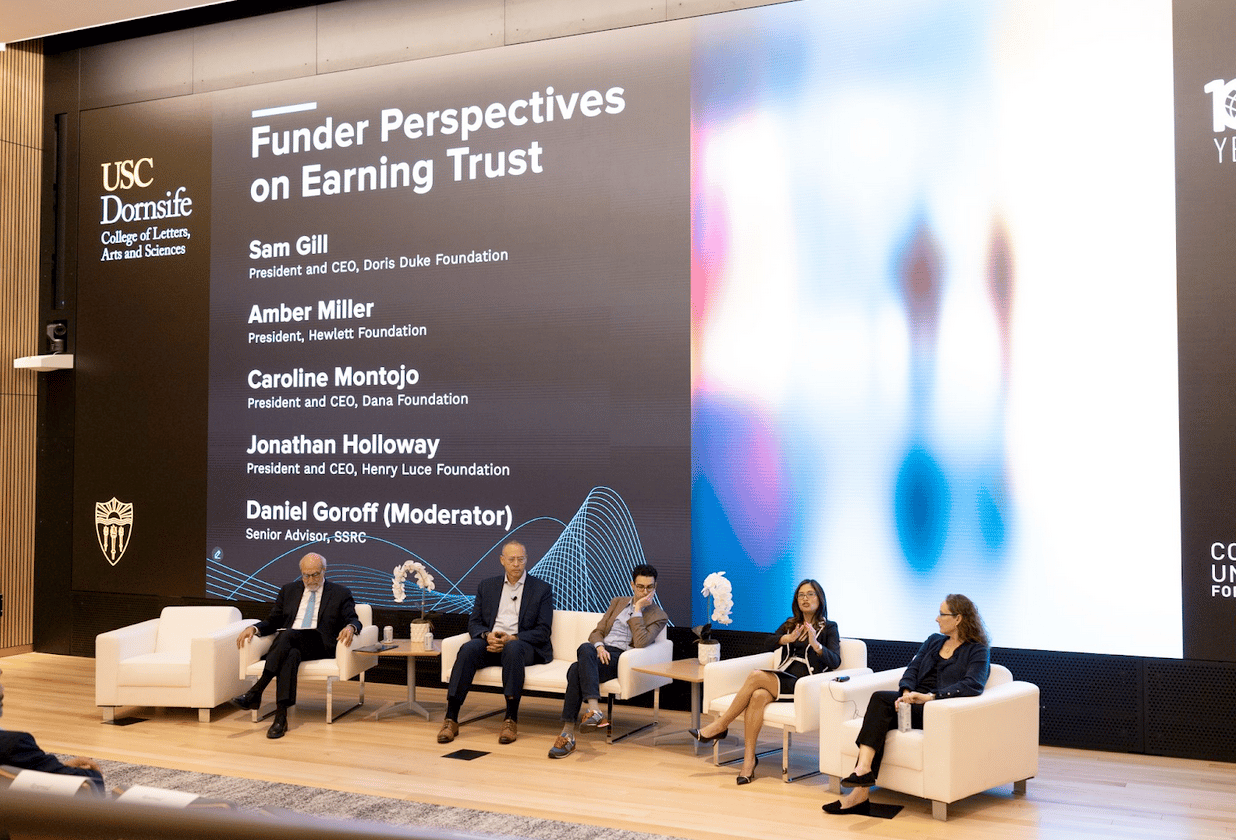
Our final panel, “Funder Perspectives on Earning Trust,” examined how funders assess leadership and credibility, as well as how university researchers can help funding organizations meet their goals as philanthropy addresses increasingly urgent challenges. Our panelists discussed the importance of humility and reliability in interacting with grantees and communities as funders and as representatives of social science.
In the above videos, Sam Gill discusses the importance of recognition in combating nihilism, and Caroline Montojo cites an example of community-driven neuroscience research on low-flying helicopter noise—leading to changed policy outcomes—in south central Los Angeles.
- Universities must function simultaneously as physical, social, and intellectual infrastructure, creating meaningful opportunities for connection across difference and creatively connecting with their local communities beyond students and faculty.
- Current levels of institutional distrust are at a flashpoint, built by political polarization and our current disinformation environment, but tensions between the populace and political and higher education institutions have existed throughout the 20th century and earlier.
- Universities can build public knowledge through a deeper collaboration with those outside the universities, and consideration of practical problems that university social infrastructure can help solve.
- Foundations can support trust-building by funding rigorous evaluation of university impact, asking local communities what social and behavioral science can do to help address their everyday concerns, and helping translate research for policy audiences.
Takeaways
SSRC Interim Co-President Woody Powell
People trust practices, and the institutions that create them, when those institutions are clear in defining their mission, treat people with respect and show their work, and put their cards on the table. So we should all aim for trustworthiness and competence, transparency, and reliability. And from that, social science tells us that trust will follow.